


Sirhornsalot
**The Official Horn Sports Landscaper and Landscap
- Joined
- Nov 6, 2013
- Messages
- 35,331
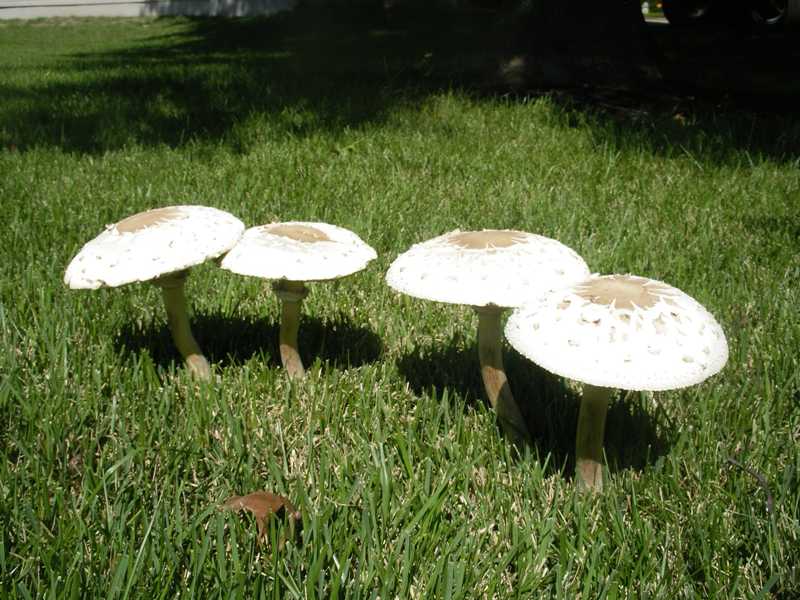
What are these mushrooms in my lawn!
One of the most common questions I get each growing season is “Help! I have mushrooms in my lawn! What do I do?â€
The answer – absolutely nothing. Or, if you’re like me, you’ll practice your field goal kicking skills with them. lol
The appearance of mushrooms in your lawn is nothing to worry about. It means you have a lot of organic matter in your turf/soil, which is a very good thing. It also means that things became damp and probably overcast for a few days. When these conditions come together, the fungi in the soil will explode and grow into mushrooms. This can happen anywhere in the lawn, even in the middle of high sunlight areas. They’ll also appear near or on decaying trees, tree limbs, stumps, etc.
These fungi are “good guys†in the lawn ecosystem. They break down organic matter into minerals and nutrients that your turf can then use. They’ll show up after a rainy spell or after laying new sod. They reproduce through spores, similar to seeds. The spores are released by the mushroom and then spread by wind or rain and drift elsewhere to start a new colony.
There are several types of mushrooms and fungi growth that can appear in the lawn. There is the typical umbrella-shaped mushroom often called “Toadstool.†There’s also other types such as puffball, shaggy mane and Japanese parasol. The only concern I have with mushrooms is the possibility of children eating them. So while I say they are nothing to worry about, it’s a good idea to get rid of them once you see them.
Lawn fungus, such as Take-All Patch, Brown Patch and DollarSpot, are a different type of fungus but can exist at the same time with mushrooms. Having mushrooms from time to time, however, does not mean you will get a lawn fungus.
Chemical Treatments This Month
You can pretty much set your watch by it, but any time we get a good rainfall in Texas during growing season, it is almost always followed up by a surge of weeds in the days following. So out the door we go and we’re either pulling weeds or spraying them.
Any weeds growing within the boundaries of a flower bed or shrub bed should be removed by hand and not by chemical. A bordered bed is contained, so a rainfall or watering will dislodge the weed killing chemical and disperse it to locations in the bed that you never wanted it to go. The result is dead and dying flowers and shrubs. So just don’t go there. Pull them.
In the lawn, however, it’s a different story. We can spray weeds and kill them without killing the desirable turf grass surrounding them.
If you’ve been using SpeedZone to treat your lawn for weeds, you should now switch to Trimec instead. SpeedZone works great during cool weather, but will leave brown burn spots in the turf when temperatures become warm to hot.

Grub control
This year, May is the month when you want to apply a grub control to your lawn. I say “this year†because the winter we just had was hardly a winter at all. When that happens, grubs will gravitate closer to the soil surface sooner and begin feeding sooner. So instead of applying in early June as we normally do, we apply in early May to adjust to mother nature’s winter curveball.
There is nothing you can do to stop grubs from being in your lawn. They begin as larvae laid approximately 5-6 inches beneath the soil surface (to avoid winter freezing). When spring arrives and temperatures warm, they begin creeping closer until finally they’re at grassroots depth and begin feeding. It is very difficult to kill grubs unless they are actively feeding/ingesting. This is a treatment that must happen each year.

Cotton Burr Compost is a wonderful thing
One organic product that has numerous beneficial uses in the landscape is Cotton Burr Compost. This product is a waste product of the cotton ginning process and includes the leaves, stems, seeds, and hulls from the Cotton plant.
There are two types of Cotton Burr Compost sold. There is a regular version and an “Acidified†version which has sulfur added. Both make for ideal natural soil conditioners.
Use in conjunction with a lawn aeration and/or as a topdressing to loosen up compacted black clay soils. You can neutralize soil pH using the regular version or increase soil pH using the acidified version.
Cotton Burr Compost is an excellent food source for beneficial organisms in the soil which fight off bad bacteria and organisms and help make minerals and nutrients available to your turf. It also improve the soil’s water retention abilities.
The acidic version can be used to treat lawn fungus, as the acid content kills the fungus.
You can use around trees and in flowerbeds and shrub beds. Just lay down a layer over the soil prior to applying your mulch.
One word of warning . . . it does have a stinky odor at first, but it dissipates after a few hours.
Choosing the right plants
May, along with April, is prime time planting season for most of Texas. Springtime weekend afternoons in the nursery can be a seductive experience. All the plants are looking their best and are in bloom. We end up wanting to buy a bunch of this and a bunch of that, but never really think about how it will perform in our own landscape’s conditions.
For instance, Encore Azaleas can be mesmerizing in the nursery and it’s easy to take one home with you. In Texas, you simply have to keep azaleas on the east or north side of your home for best results. The south and west sides will be too hot and too overbearing for azaleas to be at their best.
Lantana will grow most anywhere in Texas, but it needs all the Texas sun it can get. So plant them on the south or west side of your home.
Things to consider when buying your plants:
1. Does the plant prefer full sun, partial sun or mostly shade? What does your landscape offer in comparison?
2. The general rule of thumb – more sun, more blooms.
3. What are the plant’s water requirements? If you’re under water restrictions, will your watering satisfy the plant?
If you buy a Colorguard Yucca, do not plant it in a shady, wet environment. This is a desert plant and requires all the sun it can get. By contrast, a Japanese Maple cannot handle full day sun. Plant them in places where taller, surrounding trees will protect them.
M for Mulch, M for May
Regardless of whether or not you plant new plant material in May, it is the perfect month to mulch. In May, the Live Oaks have finished molting so the beds can be cleaned prior to mulching without fear of more dead Live Oak leaves falling. Don’t go cheap on the thickness, either. Apply at least 2-3 inches.
Don’t go cheap on mulch. The phrase “you get what you pay for†applies here. “Shredded†mulch will be slightly more expensive than ordinary mulch because of the extra time required to shred it. However, it will perform better with less float.
Cedar Mulch is a great choice for the homeowner who wants a little pest deterrent with their mulch. Cedar is a natural pest deterrent and provides a great aroma. It also has a nice, reddish brown color.
Common hardwood mulch, when shredded, is about as good as it gets. It is less expensive and has great, natural brown to dark brown color.
Cypress mulch isn’t as common as the others, but is widely available and has some nice features. Cypress mulch also has pest deterrent properties, has a nice, bleached look that stands out. It is also less likely to float.
It is not okay to mulch using the waste from a stump grinder. In many cases, the waste is coming from what was a living tree. That waste, while it looks like mulch, will begin decomposing and composting and will be a moisture hog, sucking up moisture instead of retaining it. Decomposition will also create heat, further exacerbating the problem.
I’ll open things up for questions now. I’ll answer whatever you got!
Last edited by a moderator: