


Sirhornsalot
**The Official Horn Sports Landscaper and Landscap
- Joined
- Nov 6, 2013
- Messages
- 35,442

Still feeling the effects of 2020 winter storm
Ladies and Gentlemen, welcome to Spring!
Last year, I wrote a column about the effects of the massive winter storm we experienced here in Texas. Today, I’m still writing about those effects.
Before you go rushing out the door to get your spring landscaping on, let me prepare you for what you are likely to find.
There have been price increases on certain stock in nurseries. Some of those increases are rather remarkable.
The cost of Palms went up as a result of low inventory as the winter storm not only destroyed millions of dollars of Palms last year in the Dallas/Ft Worth Metroplex, but it also killed many Palms in the nurseries. Many others were damaged and must be nursed back to health before they can be sold. So the cost of Palms have almost doubled over two seasons ago.

I can only guess at the reasons why we have such a dramatic increase in cost of Japanese Maples. Demand is up, sure, but demand is always up for this particular ornamental tree. The best I can suggest is that many of the Japanese Maples you see in nurseries here are actually grown in Oregon.
Shipping costs from Oregon have no doubt increased, but in some cases, costs compared to last year have doubled.
Other plant costs have increased, but not significantly like the Palms and Japanese Maples.
We’re about to embark on our first lawn fertilization of the season. Unfortunately, fertilizer may be hard to find this season due to so much of the product being made in Russia. Global supply is tight right now and due to the conflict in Ukraine, shipping became more challenging and thus prices have soared some 43 percent.

Lumber, such as what is used on Pergolas, overhangs, and arbors, have more than doubled over January 2020 prices. This includes rough Cedar, which is often used in these outdoor applications.
Tough to find . . .
Some species of shrubs and trees were hit particularly hard last year and immediately, they became very hard to find during the summer growing season. One example was the Indian Hawthorn. I had one customer who lost 71 of them. They were hit hard and inventories of this shrub are improving, but not where it was pre-storm. So the availability and numbers on them will again be limited.
For some reason, Dwarf Nandinas, including the Firepower, Gulf Stream and Obsession varieties are a little scarce this year. That may change in the next few months but for now, they’re not so easy to find.
Inventories of Palms are still low as well.
Ironically, so many of the plant success stories from that winter storm were the Xeriscape plants . . the desert plants such as Yuccas and Agaves.
Fertilization
As of today, you can now safely apply fertilizer or weed and feeds to your lawn. Our last freezing temperatures are past us and turf grass is now emerging from dormancy.
Remember – lawn products are often specific to certain types of grasses. Make sure you read labels or consult with a professional on what product is best for your lawn.
Weed and feed products and fertilizers made for Bermuda are not suitable for St Augustine or Zoysia turf grass. The amount of Nitrogen that Bermuda wants is much higher than what St Augustine and Zoysia can tolerate. Made for Bermuda products often have a nitrogen content of 27 or as high as 36. Meanwhile, St Augustine and Zoysia want a much milder fertilizer, with nitrogen content anywhere from 15 to 19. So applying Bermuda fertilizer products to St Augustine or Zoysia lawns can have devastating results.
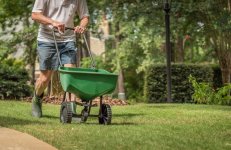
Make sure you load your hopper over a concrete surface. This is important. If you spill fertilizer trying to load it into the hopper, it can be cleaned up well on concrete surfaces. If you spill fertilizer while over turf, you’ve just killed whatever turf touches the fertilizer. Fertilizer, in modest, recommended amounts, does wonderful things to make plants and grass grow. But too much fertilizer will kill plants and turf. So avoid the issue and load up over concrete.
Every spreader will have a feature that allows you to set your spreader’s ratio. Most fertilizers will list popular spreader types and their appropriate setting for their product. Make sure you follow the recommended ratio/setting for your spreader before you begin to fertilize your lawn.
When you fertilize, remember, your spreader is casting up to three feet on each side of you. So avoid going through tight spots where your fertilizer could be cast into a landscape bed. In some cases, you may need to stop and grab a handful of fertilize and spread it by hand in places where you simply can’t run your spreader through it without getting into the beds.
This is important because lawn fertilizer is much stronger than what bedding plants can handle. So its important not to cast into the beds, it could cause damage to your plants.
Inevitably, you will get some fertilizer on your concrete surfaces, such as your driveway, your sidewalks, or your patio. As soon as the spreading is done, be sure to take a blower and blow these surfaces clean. Fertilizer can stain concrete so you do not want to leave it behind.
To improve the effect your fertilizer will have on your turf, you might want to time your application before a rain event, as long as it isn’t a downpour event. Rain water has many more oxygen molecules with each drop compared to tap water. Your turf roots (as well as any plant) can absorb more nutrients when more oxygen is available. So you get a very nice response doing it this way.
It is a risk, however, as rain events can be rather unpredictable in size and scope. A large torrential rain event could send your product down the street.
If you’ve applied with no rain in the forecast, make sure you water as soon as you finish applying it. The sun’s rays can bake some of the potency from your fertilizer if you don’t water it in.
Inevitably, I get asked for recommendations for fertilizer. What product do I like best and why. For St Augustine and Zoysia turfs (both turfs are treated with the same products), I really like Fertilome’s St Augustine Weed & Feed. The nitrogen is high quality and the Atrazine (weed killer) is as well. They make the product with a slight acidic content addition which St Augustine and Zoysia respond well to.
For Bermuda, I really like Scott’s Lawn Pro and also their Turfbuilder products. I want to point out that I do not have much faith in the stacking of features worked into these products, such as Turfbuilder with insect and grub worm killer etc. Just plain Turfbuilder is a great product though and will make a Bermuda lawn thick and lush.
Once you’ve applied your fertilizer in early April, your next application will not need to happen until mid to late June. There are only three applications per year.
Happy Fertilizing!
Annual Flowers!
Now that April is here, the nurseries will be packed with annual flowers. There will be all types of flowers, some of them almost too tempting to walk by. But if you’re buying your flowers with the idea that you want them to last the entire summer – that really narrows your list down to Begonias, Periwinkles, and also Wave Petunias.
Wave Petunias have a running growth habit, so they also work well in hanging baskets and pots where they will hang down. Begonias and Periwinkles are very durable flowers and will make it through our hot Texas summers.
Sprinklers!
Now that we’re emerging from winter, now would be a great time to have your sprinkler system checked for proper function and operation. It is best to do it now rather later so you don’t have to lose any turf or flowers as a result of something that broke during the winter.
In the Metroplex, you should be watering at least twice a week with the current climate we’re having. As temperatures rise into the upper 80s and into the 90s, add a third day to the schedule. Later, in the heat of summer when temperatures are reaching 100 each day, you will want to add a fourth day to the schedule.